

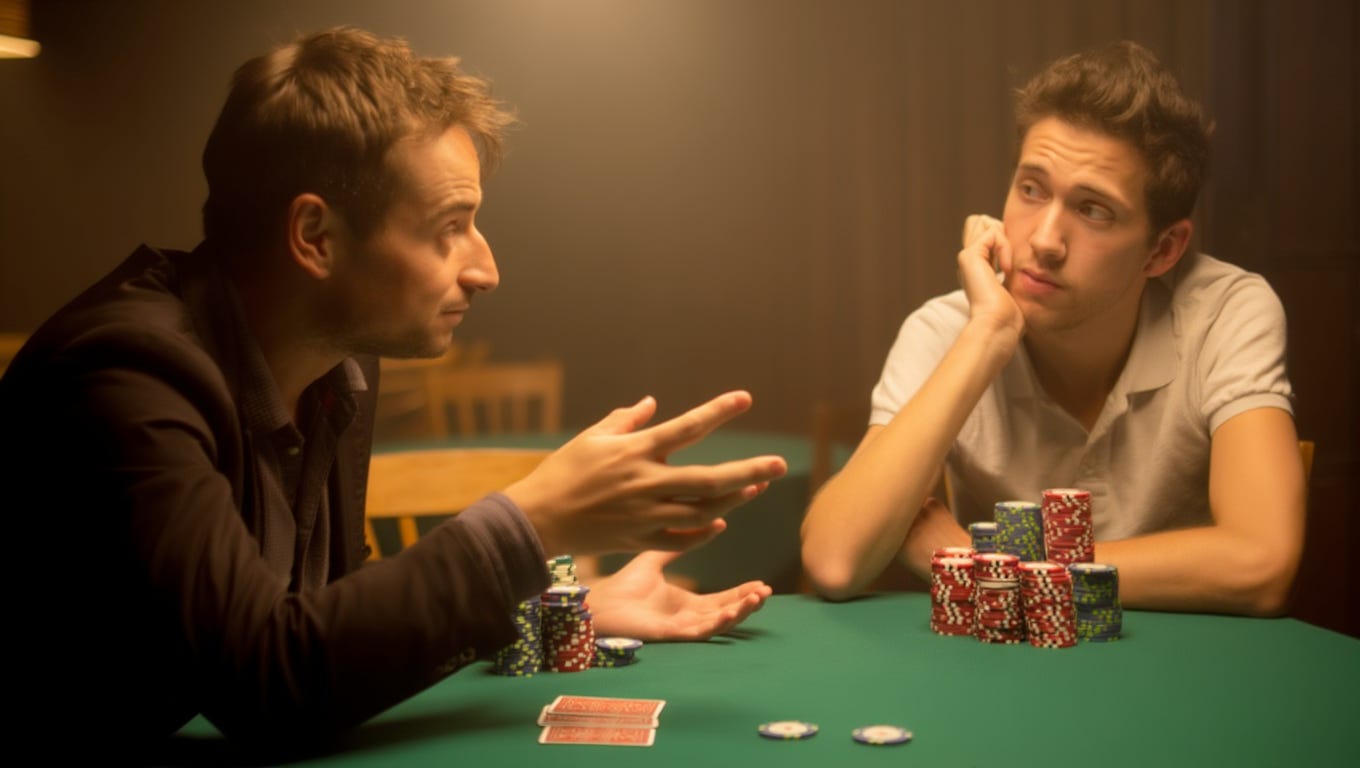
Here’s the story of a legendary poker hand:
Our hero decides to play with 72, which is the worst hand in Holdem and theory says he was supposed to have folded but he played it anyway.
Later he bluffed all-in with 7332 on the board and the villain was thinking about whether to call. At this point our hero offered a side bet: For a fee you can look at one of my hole cards of your choice. The villain paid the fee and happened to see the 2, at which point he incorrectly deduced that the hero must have 22 as his hole cards and folded.
What’s going on here is that the villain had a mental model which doesn’t include side bets. It may have been theoretically wrong to play 72, but in a world where side bets are allowed and the opponent’s mental model doesn’t include them it can be profitable. The reveal of information in this case was adversarial. The fee charged for it was misdirection to make the opponent think that it was a tradeoff for value rather than information which the hero wanted to give away.
What the villain should have done was think through this one level deeper. Why is my opponent offering this at all? Under what situations would they come up with it? Even without working through the details there’s a much simpler heuristic for cutting through everything: There’s a general poker tell that if you’re considering what to do and your opponent starts talking about the hand that suggests that they want you to fold. A good rule of thumb is that if you’re thinking and the opponent offers some cockamamie scheme you should just call. That certainly would have worked in this case. This seems like a rule which applies in general in life, not just in Poker.