

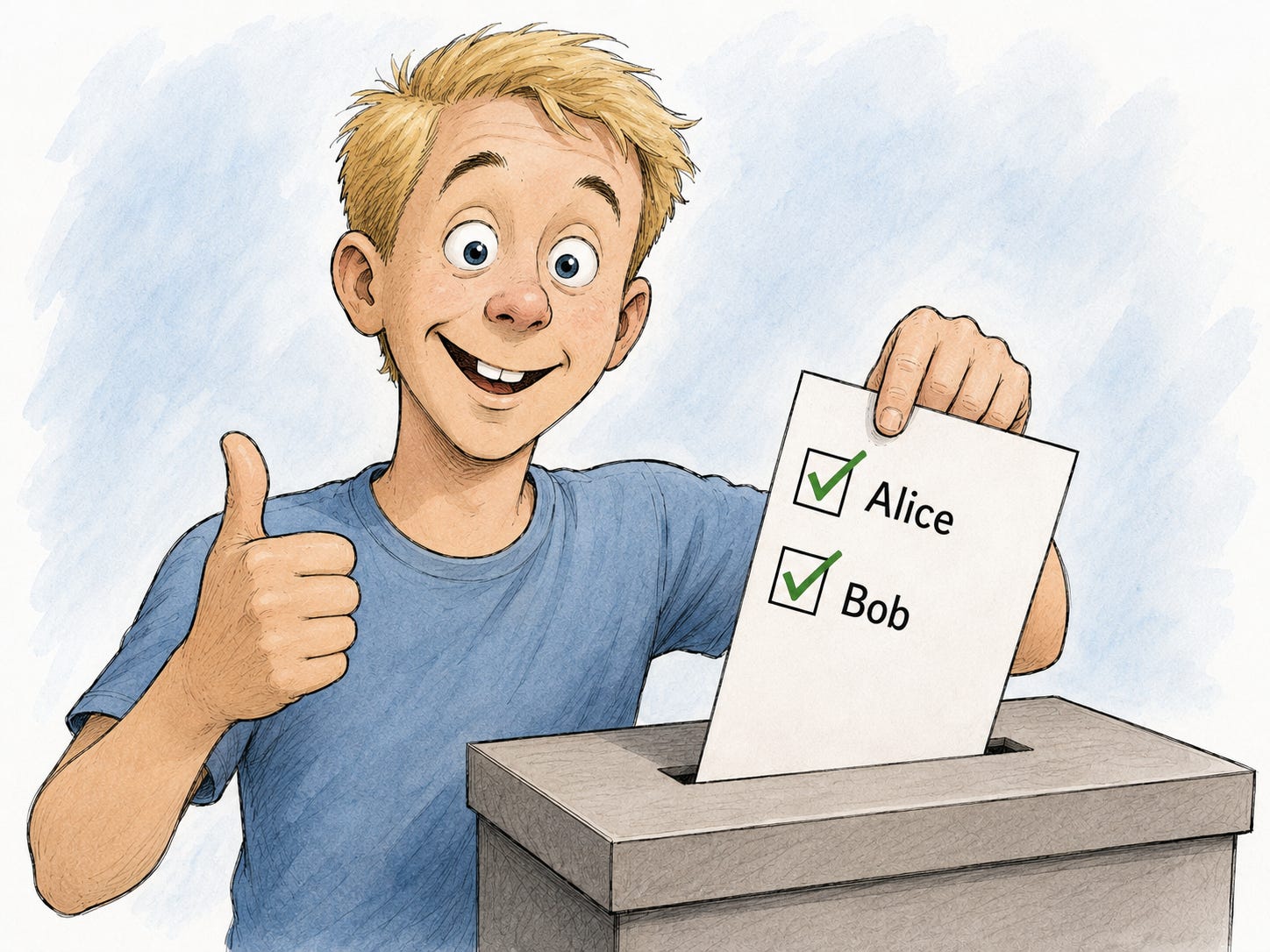
Approval voting is an election method voters say ‘yes’ or ‘no’ to each candidate and whoever gets the most ‘yes’ votes wins. It isn’t a popular or good idea. It’s mostly promoted by one guy, but the internet being what it is he’s managed to make the appearance that it’s a serious thing, based mostly on having gotten a real math paper published and once having convinced a very geriatric Kenneth Arrow to be interviewed who then acted like a gracious guest. I’ve now spent an unjustified amount of time arguing with this person and digging into what that paper says, so I’ll explain what’s wrong with it for your benefit.
When argued with this person does a lot of talking about ‘math’ and ‘theorem’. Those familiar with Arrow’s theorem might find this a little odd. Arrow’s theorem is a theorem. How could two theorems say contradictory things? It comes down to what assumptions you make. Assumptions may or may not correlate with the real world. Which theorem applies is an empirical question about which one’s assumptions are most accurate.
The core insight of Arrow’s theorem is this: Consider an election which there are three parties, the Alice, Bob, and Carol parties, named after their preferred candidates. They’re all close to the same size, and the Alice party’s preferred candidates are Alice, then Bob, then Carol, in that order. For the Bob party it’s Bob, Carol, Alice, and for the Carol party it’s Carol, Alice, Bob. This is a very strange and confused scenario which doesn’t happen very often in practice, but it can happen, and Arrow’s theorem basically says there’s no perfect way to handle it, although there are reasonable things which can be done in practice.1
The paper in question is spun as claiming that approval voting is a loophole around the no spoilers criterion. That criterion specifically says that if one candidate would beat another in a two-way race, then adding in a third candidate who doesn’t win shouldn’t switch it to the other candidate. Consider what happens in the difficult case described above when we’re using ranked choice ballots. Let’s say the numbers of members of the three parties are very slightly different and the tiebreak we choose happens to pick Bob. This is a problem because in a two way race Alice would beat Bob with 2/3 of the vote but now Bob wins because of Carol having been introduced even though Carol didn’t win. The same argument applies when either of the other two candidates win.
Intuitively it seems like moving off of ranked choice ballots should make gameability worse rather than better. It allows voters to express their preferences in every scenario and the vote ranking algorithm to use all of that information. It turns this is exactly what happens for approval voting: The simplicity of picking a winner masks yet even greater opportunities for voters to get what they want by voting dishonestly. Only if you assume the fallacy that by limiting what voters can express to approve/disapprove you’ve successfully forced them to limit their preferences to approve/disapprove does it hold up.
Consider the difficult case with approval voting. Let’s say the voters vote completely honestly. Or maybe they vote strategically based on some complex negotiation which happened ahead of time. Which assumption you make doesn’t matter for getting to the conclusion. One way or another, one of the candidates will win. Let’s say it’s Bob. Why won’t Alice beat Bob in a two-way race? The details are a bit involved (this was, in fact, the subject of a publishable paper) but it rests deeply on a fundamental assumption: Because the ballots are yes/no, the feelings of the voters about candidates are yes/no. In particular, it assumes that in a two way race between Alice and Bob voters who like both candidates or dislike both candidates will state so honestly, putting in a wasted ballot, instead of strategically voting yes to the candidate they like more and no to the candidate they dislike more. They’re supposed to say ‘Both candidates are great, don’t care’ or ‘Two evils, no lesser’. Any voters who do otherwise are Bad, Immoral, and defiling the mathematical beauty of the voting system. This is, to put it politely, an unrealistic assumption, and real world voting systems should not be designed based on it.
There are other arguments which could be made for and against approval voting but no-spoilers was chosen as the supposedly unassailable point in its favor so having debunked it I’m now going to declare victory rather than doing a comprehensive review of voting systems. Ranked choice remains the best option, with some tweaks like allowing voters to list candidates as tied in preference being legitimate practical improvements.2
The best algorithm in practice is to use ranked choice ballots and say that whoever would win a 2-way race against every other candidate is the winner. If there’s no single candidate who meets that criterion then you remove whichever candidate got the fewest first place votes and repeat the process. In addition to being simple and easy to explain, this minimizes gameability by minimizing the amount of information used from each ballot and maximizing the amount of deviance voters have to make from their honest preferences if they try to game the system.
There’s still some spoilage or at least judgement calls necessary. For example if there are 5 cadidates in a race and someone votes three of them in third and no votes for the others do they want those to be ahead of or behind the other two?
Sounds like you'd like more expressiveness in a voting method, so score voting is what you want, not ranked voting. That also avoids this problem.
Approval Voting demonstrably works well, and has easy to understand results. The problem with RCV isn't just that it produces failures like in Alaska: https://ranked.vote/report/us/ak/2022/08/cd but also that the results can be so complex that people don't trust the results. There are many, many instances of elections where the candidate with the most first place votes lost. While you and I know that's the whole point of RCV, it erodes trust:
https://ranked.vote/report/us/ca/alameda/2022/11/oakland-mayor
https://abc7news.com/post/sheng-thao-indictment-loren-taylor-mailers-oakland-mayoral-race/15811727/
Approval Voting working well:
https://felixsargent.com/democracy/2025/08/29/st-louis-approval-voting.html
This piece is exactly as good as careful reasoning produces when you haven't read the empirical literature before publishing: confident, internally consistent, and wrong at the foundation.
Start with the most fundamental error, because everything else flows from it. You argue that approval voting works only under the assumption that voters' underlying preferences are binary—that someone who approves both Alice and Bob genuinely feels equal about them, and will remain indifferent in a two-way race. You call this unrealistic and conclude the system breaks down under strategic reoptimization.
Nobody in the approval voting research literature claims voters' preferences are binary. Nobody. The Bayesian regret simulations—the actual quantitative framework used to evaluate voting methods—assign voters continuous cardinal utility values, then model how those voters make decisions under each system. That's the whole point: test performance with realistically non-binary preferences and see what happens. What you've done is invent a claim that advocates never made, refute it, and declare victory. The research doesn't say "approval voting is good because preferences are binary." It says "approval voting produces better outcomes than IRV when you aggregate realistically non-binary preferences through each system's mechanism." That's an empirical claim about outcomes, verified by simulation, and your piece never touches it.
The right framework for comparing voting systems isn't criteria-satisfaction under idealized assumptions. It's: which system produces outcomes closest to what voters actually want, given realistic mixtures of honest and strategic behavior? That question has been answered rigorously by Warren Smith's Bayesian regret calculations at ScoreVoting.net and independently by Jameson Quinn's Voter Satisfaction Efficiency simulations. Both evaluate roughly fifty voting methods across tens of thousands of simulated elections with voters modeled at various honesty levels. The result is consistent: score voting wins, approval voting performs well above IRV, and IRV clusters near the bottom of reasonable single-winner methods—comparable to plain plurality in some configurations. In the 50% strategic / 50% honest voter model—the one critics predicted would be approval voting's worst case—approval voting still beats IRV with every single voter being honest. IRV's strategic profile is that bad. Writing a piece dismissing approval voting without addressing Bayesian regret is like arguing a drug doesn't work while declining to read the clinical trial results.
Now the expressiveness argument, which you imply and IRV advocates make explicitly: ranked ballots are more expressive than approval ballots, therefore ranked systems capture more voter information, therefore they produce better outcomes. This is wrong in a specific way worth naming. The expressiveness that matters isn't at the ballot level—it's at the tabulation level. A ballot can carry a lot of information that the algorithm promptly discards.
Consider a three-candidate race where 335 voters prefer hot then warm, 333 prefer cold then warm, and 332 prefer warm. Under IRV, warm is eliminated first for having the fewest first-choice votes. But 67% of voters prefer warm to hot, and 67% prefer warm to cold. Warm is the Condorcet winner by a landslide. The ranked ballots contained that information. IRV threw it away, because IRV only looks at your second choice after your first has been eliminated—and warm voters' second choices never mattered because warm was gone in round one. Under approval voting, most of those 335 and 333 voters approve warm as an acceptable second choice, and warm wins. The supposedly "less expressive" system produced the better outcome because its tabulation mechanism actually used the available information.
This isn't purely hypothetical. Alaska 2022 is the textbook example. Nick Begich was the Condorcet winner—he beat both Sarah Palin and Mary Peltola head-to-head. He was eliminated in round one for having the fewest first-choice votes. Peltola won despite a majority of Alaskans preferring Begich over her. Palin was the Condorcet loser—she lost every head-to-head matchup—yet her presence split the Republican vote and handed the election to the opposite party. That's the spoiler effect, the one IRV is specifically supposed to prevent. The election also exhibited monotonicity failure: had some Palin bullet voters instead supported Peltola, Peltola would have lost. Gaining votes caused the winner to become a loser. Burlington 2009 had the same structure—IRV eliminated the Condorcet winner, exhibited non-monotonicity, and Burlington repealed IRV 52-48. When the mayor tried to bring it back two years later, voters rejected that too, 58-42.
These failures aren't the norm numerically—out of 463 documented US RCV elections, only 11 exhibited serious pathologies like Condorcet failure or monotonicity failure, and the Condorcet winner prevailed in the vast majority. But filter to elections with genuinely competitive third candidates—the exact scenario IRV is supposed to handle better than plurality—and the failure rate climbs to 3.4%. More importantly, the theoretical possibility of these failures shapes behavior even when they don't trigger. After Alaska 2022, two viable candidates dropped out of the 2024 rematch specifically to avoid being spoilers. That's the system working exactly as critics predict: rational actors defang the multi-candidate environment that IRV was supposed to enable. A study of hundreds of RCV elections found that candidate counts spiked after adoption and then receded within just a few elections, as parties learned the incentive structure. The pathology doesn't have to occur frequently to be corrosive—it just has to be possible, and known to be possible by the people deciding whether to run.
The bullet voting argument runs empirically backwards. The claim—made loudest by FairVote—is that strategic approval voters will simply approve only their top candidate, collapsing the system into plurality. Theoretically wrong: the optimal approval strategy is to approve every candidate you prefer over the expected value of the winner, which in any competitive race typically means several candidates. Bullet voting sacrifices voting power; NES polling data bears this out—about 90% of 2000 voters who preferred Nader voted for someone else, demonstrating that most voters optimize for electoral impact rather than pure preference expression. Empirically wrong: in the 2002 French presidential approval study, only 11.1% of ballots were bullet-style with total approvals at 315%. In the comparable 2007 San Francisco IRV mayoral election, 53% of ballots were bullet-style with total rankings below 187%. IRV produced nearly five times more bullet voting than approval voting. St. Louis's 2025 approval mayoral race showed 32.8% of voters approving multiple candidates, with 84% of minor-candidate supporters expressing additional preferences—exactly the voters whose voices would have been lost under plurality.
Your footnote deserves attention because it's where your actual prescription lives: use ranked ballots, find the Condorcet winner if one exists, fall back to eliminating last-place finishers otherwise. Condorcet+IRV sounds reasonable. It appears in the Bayesian regret simulations and performs worse than plain approval voting under realistic mixed-voter conditions. More ballot information doesn't guarantee better outcomes when strategic voters exploit that information asymmetrically. Approval and score voting's robustness to strategy comes precisely from the simplicity of the ballot structure limiting the surface area for gaming.
On Kenneth Arrow: dismissing his appreciation for score and approval voting as geriatric politeness is an ad hominem that is also factually incorrect. Arrow said clearly and on the record that his impossibility theorem applies to ranked-order social welfare functions, and that score-based systems occupy a different mathematical space where his theorem's assumptions don't apply in the same way. He wasn't being gracious. He was being precise—his professional specialty for seventy years. His view can be disputed, but "he was just being nice to a persistent young man" is not how you dispute it.
The conclusion that ranked choice remains the best option is unsupported by the evidence you examined and directly contradicted by the evidence you didn't. The Bayesian regret simulations are decisive on their own. The real-world record adds insult to injury: Burlington repealed IRV, Alaska nearly repealed it, six state ballot measures to expand it all failed in 2024, 19 states have banned it outright, and its flagship elections keep producing the exact pathologies it was supposed to eliminate. Approval voting's record includes Fargo and St. Louis, where voters understood it immediately, used it as intended, and expressed preferences that plurality would have buried. The simulations and the elections point in the same direction. The case isn't close.