

When playing melodies the effects of microtonality are a bit disappointing. Tunes are still recognizable when played ‘wrong’. The effects are much more dramatic when you play chords:
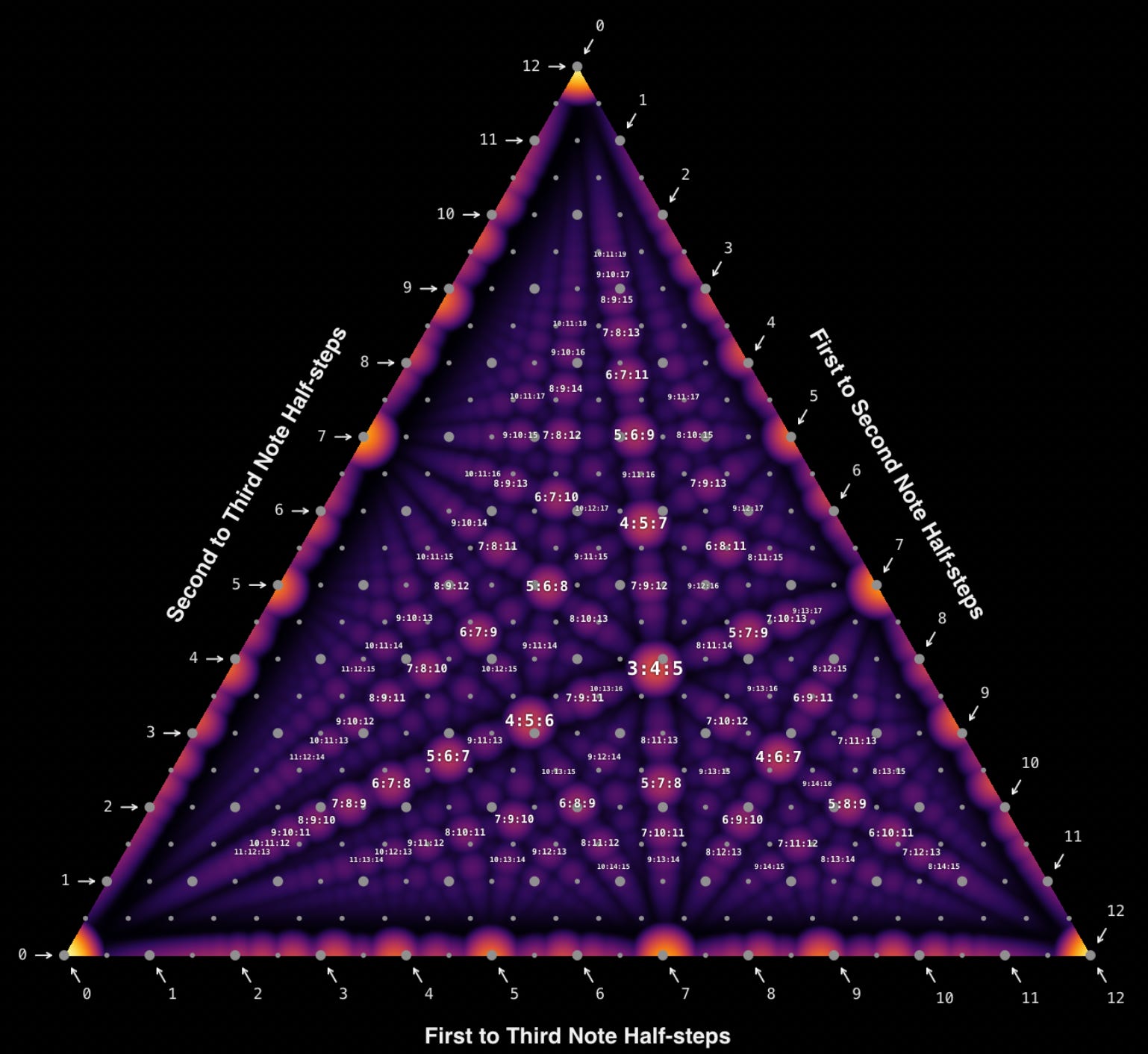
You can and should play with an interactive version of this here. It’s based off this and this with labels added by me. The larger gray dots are standard 12EDO (Equal Divisions of the Octave) positions and the smaller dots are 24EDO. There are a lot of benefits of going with 24EDO for microtonality. It builds on 12EDO as a foundation, in the places where it deviates it’s as microtonal as is possible, and it hits a lot of good chords.
Unrelated to that I’d like to report on an experiment of mine which failed. I had this idea that you could balance the volumes of dissonant notes to make dyads consonant in unusual places. It turns out this fails because the second derivative of dissonance curves is negative everywhere except unity. This can’t possibly be a coincidence. If you were to freehand something which looks like dissonance curves it wouldn’t have this property. Apparently the human ear uses positions where the second derivative of dissonance is positive to figure out what points form the components of a sound and looks for patterns in those to find complete sounds.
This sounds insightful, I wish I knew enough music theory to understand it. The previous posts on music theory were very educational!