

Before reading this post you should read through my last post on music theory. Here are a few slightly more advanced things.
The Major Chord
The notes of the major chord all come from the overtones of one note, like this, with the overtone keys labeled with red numbers for their ratio from G1:

The combination of all these notes is literally the major chord, as in all chords called major are subsets of it. The most common canonical major chord is the one on 4, 5, and 6, labelled gray in this picture. Adding in 7 or 9 gets spicy, especially if you keep in 8 or 10 or move them to 7/2 or 9/2. Music with that spiciness added is generally referred to as ‘jazz’. 11 and 13 aren’t things at all which is why I didn’t include them. You might notice that the tonic here is placed on the G instead of C. That’s to make the 7 land on a white note. A strong case can be made that in jazz the default major mode should be Wednesday instead of Tuesday.
The Minor Chord
The notes of the minor chord are all undertones of one note. Here they are with the blue labels being the undertone ratios from A6:

Like with the major chord this is the source of all minor chords. The most common subset is the ones labelled in gray, which is usually what people mean when they simply say ‘a minor chord’. This is slightly awkwardly placed with the tonic on D even though the note at the center of everything is A. The source of the asymmetry with major is that the human ear perceives the defining part of a chord as being its lowest note. Undertone series tend to sound less consonant than overtone series. Also as with the major chord 7 and 9 are spicy especially with 8 or 10 or moved to 7/2 or 9/2. This diagram is positioned so 7 and 9 land on the diatonic scale. It illustrates that a strong case can be made that the default mode for jazz minor pieces should be Thursday and not Friday.
The Blues Scale
The blues scale is the pentatonic scale with one more ‘blue’ note added. It’s best thought of as being midway between two different just intonations, like so:
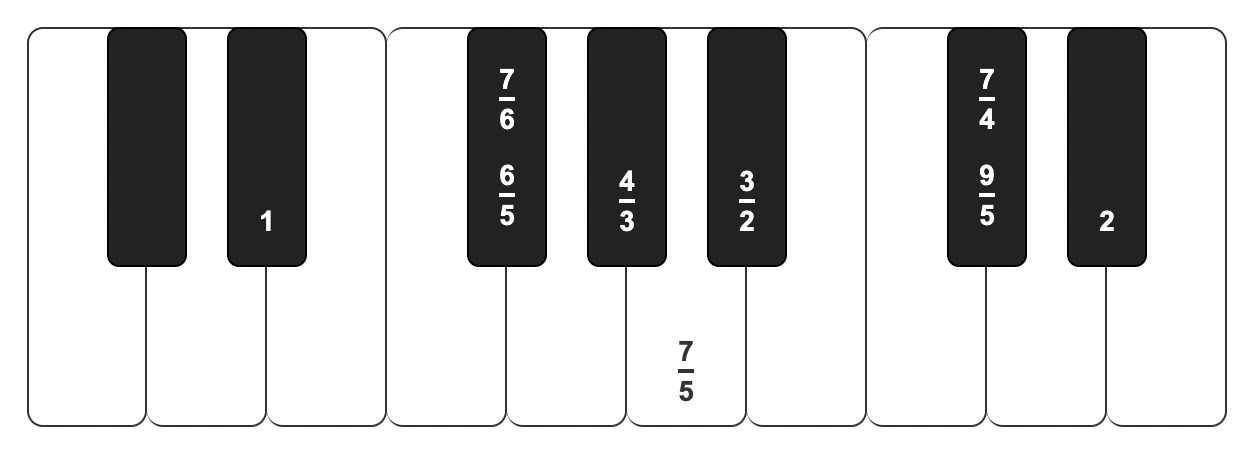
With that aggressive use of 7-limit intervals and multiple things to bend to blues works well with guitar.
Well Tuning
With just intonation the second, tritone, and minor seventh can all be reached either by going up or down resulting in them having two natural values which vary by a syntonic comma, like so:
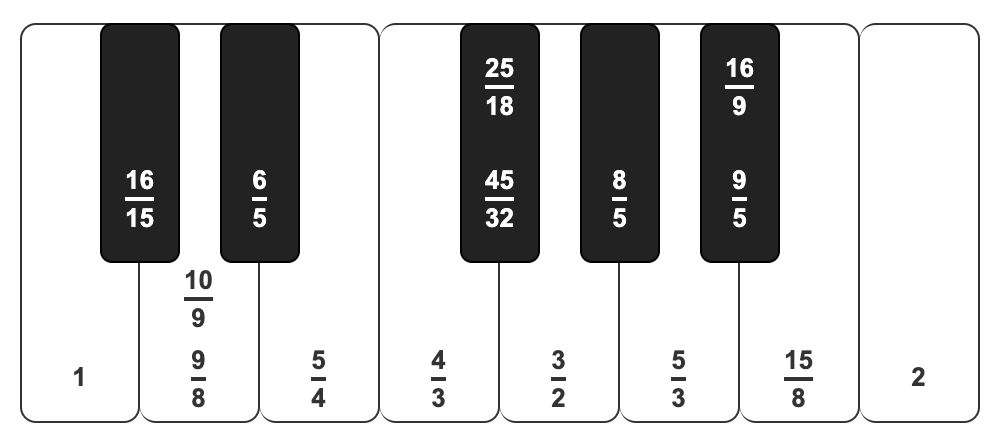
Tuning a piano to the midpoint of these value is an example of what’s called ‘well tuning’ where all the keys sound good. There are many different types of well tuning. This is the easiest one to tune a real piano if you don’t have special equipment and is also the most just flavored. The standard equal temperament tuning is the most smoothed over.